
What it is
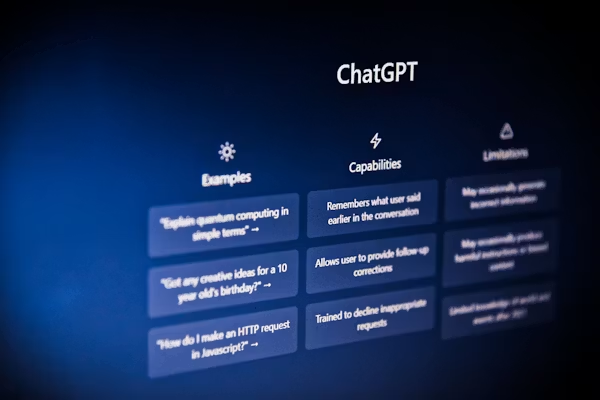
ChatGPT is a chat interface on top of a large language model. You type something, it replies.
Two words worth separating.
The model is the underlying system — trained on an enormous amount of text, predicting the most likely continuation of whatever you give it.
ChatGPT is the product wrapped around it: a conversation view, memory of the current thread, and a set of tools.
Other products use similar models — Claude, Gemini, Copilot. ChatGPT became the name people use for the whole category, the way “Hoover” did for vacuum cleaners. When somebody says “connect ChatGPT to our system”, they usually mean “connect a language model”, and the specific one is a separate decision.
How it works, briefly
It predicts the next word, given everything before it.
Ask a question, and it produces the most likely answer text — word by word, each influenced by the whole conversation so far.
Three consequences worth knowing:
It does not look anything up unless connected to a source. By default it is producing text from patterns, not retrieving facts.
It is fluent whether or not it is right. There is no internal signal saying “I am unsure here”, and no formatting cue in the output.
It knows nothing about your business unless you tell it, or unless it is connected to your systems.
FIGURE 1: THREE THINGS TO HOLD ON TO
It predicts, it does not retrieve
- No lookup unless connected to a source.
Fluent is not the same as correct
- Wrong output reads exactly as well as right output.
It knows nothing about you
- Not your customers, your prices or your stock — unless you supply them.
What businesses actually use it for
Setting aside the demonstrations, four things.
Drafting. Emails, descriptions, articles, proposals. It removes the blank page.
Summarising. A long thread, a long document, a long meeting transcript.
Rewriting. Shortening, changing tone, adapting one message for a different audience.
Explaining. Turning something technical into something a colleague can read.
All four are worth having. All four need reading before the output is used.
What it is poor at
Facts it does not have. It will produce them anyway, confidently. Prices, specifications, dates, availability.
Current information. Its training has a cutoff. Unless connected to a live source, anything recent is guesswork.
Your business specifics. Your customer’s payment history, your stock levels, your terms.
Arithmetic and reasoning chains. Better than it used to be, still not reliable enough to trust unchecked on anything numeric.
Legal precision. Contracts, terms, compliance statements.
The paid and free question
Worth understanding, because it affects your data.
Free tiers are typically slower, use older models, and — importantly — often use your conversations to train future models.
Paid business tiers are faster, use current models, and usually state that your data is not used for training.
If you are pasting customer information, contracts or anything confidential, this distinction matters. Read the terms of whatever you are using, and check which tier your team is actually on.
FIGURE 2: THE DATA QUESTION
Ask before using it for work
- Is our data retained, and for how long?
- Is it used to train their models?
- Does this meet our obligations for personal data?
- Which tier is the team actually on?
Common mistakes
- Pasting customer data into a free account
- Assuming the paid terms apply to everyone
- Never reading the terms at all
- Different people on different tiers
ChatGPT and your business system
The question that comes up: can we connect it to Odoo?
Technically yes. Three levels, with very different risk.
Drafting inside your system. It writes text in the screen you are already in. Straightforward and useful.
Answering questions about your data. Ask in plain language instead of building a report. Useful, and verify anything you act on — the definitions it used may not be yours.
Taking actions. Creating records, updating fields, sending messages. This is where the risk is.
A workable boundary: let it prepare things. Draft the quotation, populate the record, compose the message. A person confirms.
Draft-and-confirm captures most of the time saving and almost none of the danger.
And check what Odoo already does natively first. Odoo now includes AI across the system, and for drafting, summarising and document reading you may not need an external connection at all — which means fewer moving parts and a clearer data path.
FIGURE 3: THE BOUNDARY WORTH KEEPING
Safe — prepare
- Draft a quotation for review
- Populate a record, unsaved
- Compose a message, unsent
- Summarise a customer’s history
Risky — commit
- Confirm an order automatically
- Post a journal entry
- Send to a customer unread
- Change data on its own judgement
Getting better results
Four techniques, in order of effect.
Give examples. Three pieces you like beats any description of what you want. This is the biggest single improvement available.
Give facts. Paste in the real details rather than letting it fill gaps. Most invented specifications come from missing information.
Say who it is for. “Write for a warehouse supervisor who is not technical” produces different text from “write for a finance director”.
Iterate. The first output is a draft. Say what is wrong with it. That is faster than rewriting from scratch.
What not to do
Do not paste confidential data into a free account.
Do not send anything to a customer unread.
Do not trust numbers without checking.
Do not use it for anything with legal weight without a professional reading it.
Do not assume it knows current information. Unless it is connected to a live source, it does not.
The realistic view
It is a capable assistant whose work you check.
That is a smaller claim than the marketing and a bigger one than the sceptics allow. For drafting, summarising and rewriting, it saves real hours. For anything factual, it needs a source or a reviewer.
Judge it by one question: what does it do, and how would I know if it were wrong?
The short version
ChatGPT is a chat interface on a language model that predicts text. It is good at drafting, summarising and rewriting.
It is fluent whether or not it is correct, and it knows nothing about your business unless you tell it.
Check which tier you are on before pasting anything confidential. Keep a person on anything a customer sees or anywhere money moves.
And check what your business system already does natively before connecting anything external.
Wondering how to use this properly in your business?
Get in touch. We will start with what Odoo already does natively — often more than people expect — before adding anything that sends your data elsewhere.