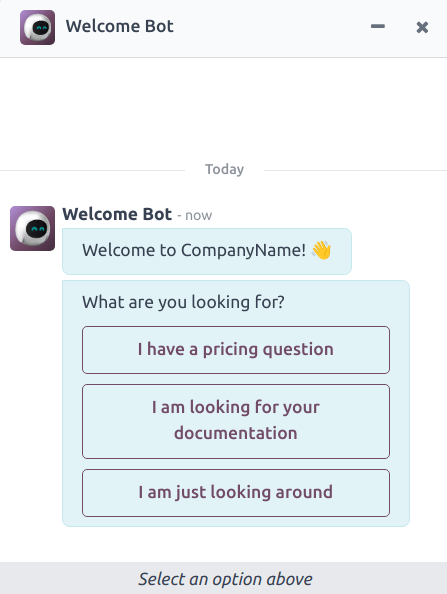

Two different jobs
Chatbots get discussed as one thing. They are two.
Support bots answer questions from existing customers — order status, policies, troubleshooting. That is covered in the customer support article.
Website bots talk to people who are not yet customers. Answering pre-sales questions, capturing enquiries, booking meetings.
This article is about the second. The economics and the risks are different.
What a website bot is actually for
Not “engagement”. Three specific outcomes:
Answering a question that would otherwise cause someone to leave. Do you ship to my country. Do you do this in stainless steel. What is your minimum order.
Capturing an enquiry from someone who would not fill in a form. Some people will type a question into a chat box who would never complete a contact form.
Booking a meeting with someone who is ready to talk now.
That is the list. A bot that does those three things well is worth having. A bot that tries to be a conversational experience is usually costing you enquiries.
FIGURE 1: THE THREE JOBS WORTH DOING
Answer the blocker
- One factual question that would otherwise make someone leave.
Capture the enquiry
- Some people will chat who would never fill in a form.
Book the meeting
- For the person who is ready to talk right now.
Why Odoo helps here
Because it is one database, a chat conversation is not an isolated event.
A conversation can become a lead directly, with the transcript attached and the source recorded.
A returning customer is recognised. If they are logged into the portal, the bot knows their orders and can answer without asking them to repeat anything.
Product and stock answers are real. Availability comes from your actual inventory, not a page someone updated last quarter.
The handover keeps the context. When a person takes over, they see everything already said.
A bolted-on chat widget can do none of these without integration work, and integrations drift.
The rules that decide whether it helps
Four, and breaking any one of them costs you more than the bot saves.
1. Escape after one failure
If the bot cannot answer, it should say so and offer a person immediately.
Not after three attempts. Not after asking the visitor to rephrase. Once.
A visitor being asked to reword their question is a visitor forming an opinion about your company, and it is not a good one.
2. Say it is a bot
Do not give it a human name and photograph. People work it out, and being caught pretending costs more trust than the automation saves.
3. Keep the scope narrow
Define what it handles: shipping questions, availability, pricing basics, booking a call. Everything else goes to a person or a form.
A bot with a small confident scope is useful. A bot claiming to handle everything produces confident wrong answers on the questions that mattered most.
4. Never let it commit
No prices it invents. No delivery dates it estimates. No promises about what you can do.
If the answer is not a fact from your system, it should not be given as one.
FIGURE 2: BOTS THAT EARN ENQUIRIES AND BOTS THAT LOSE THEM
Set up well
- Narrow, defined scope
- Admits its limits after one failure
- A person is one click away
- Only states facts from your system
Set up badly
- Claims to handle anything
- Asks the visitor to rephrase, repeatedly
- The route to a human is hidden
- Invents prices and delivery dates
The proactive message
The pop-up that appears after a few seconds.
Used badly, it is the most irritating thing on the internet. Appearing immediately, on every page, blocking content on a phone.
Used well, it works:
- After some real time on the page, not on arrival
- On pages showing genuine intent — pricing, a specific product, contact
- With a specific question, not “Hi! How can I help?”
- Easy to dismiss, and staying dismissed
Never on a phone before the visitor has read anything. Screen space is limited, and covering the content they came for is a fast way to lose them.
Handover
The moment the bot passes to a person is where most of the damage happens.
During working hours: the transcript goes with it. The visitor never repeats themselves. If nobody is free, say so honestly — “everyone is with a customer, we will reply within the hour” beats silence.
Outside hours: be clear that it is out of hours, capture their details and question, and set an expectation for when someone will respond. Then meet it.
Never leave someone waiting on a bot with nobody behind it. A chat window with no reply is worse than no chat window.
FIGURE 3: A CONVERSATION THAT ENDS WELL
Visitor asks
- A pre-sales question
Bot answers or admits
- One attempt, then hand over
Person or capture
- Live agent, or details taken
Lead created
- Transcript and source attached
Measuring it
Conversations started. Volume.
Conversations resolved by the bot. How much it actually handled.
Escalations. How often a person was needed. Not a failure metric — a well-scoped bot escalates often and that is correct.
Leads captured. The number that justifies it.
Abandonment. How often someone leaves mid-conversation. If this is high, the bot is frustrating people.
Watch abandonment most closely. It is the metric that tells you whether the bot is helping or driving people away, and it is the one that rarely appears in vendor demos.
What to avoid
Deploying it everywhere at once. Start on one or two high-intent pages.
Making it the only route to contact. Keep the form and the phone number visible.
Leaving it unattended. A bot with no people behind it captures enquiries into a void.
Judging it by conversation count. Lots of conversations that go nowhere is activity, not results.
When not to have one
Three cases where the honest answer is no.
Low website traffic. If you get thirty visitors a day, a contact form and a phone number are enough.
Complex, considered purchases. If every enquiry needs a real conversation, a bot adds a step before the conversation people actually want.
No capacity to respond. If enquiries already sit unanswered, generating more of them is not an improvement.
The short version
A website chatbot is a capture tool with a narrow answering job. It works when it is scoped tightly, honest about being a bot, and one click from a person.
It fails when it tries to be the whole conversation.
Escape after one failure. Never invent a fact. Watch your abandonment rate. And make sure there is somebody behind it.
Getting website traffic but few enquiries?
Get in touch. We will look at where visitors drop off before recommending a bot — sometimes the answer is a clearer page, not a chat window.