The problem
What a team knows is spread across three places, and none of them are readable.
The code is accurate and complete, and very slow to read. The issue tracker holds every decision that was ever argued over, buried in comment threads. The chat holds the rest — what was agreed on a Tuesday afternoon and never written down anywhere else.
New developers spend their first weeks reconstructing this. Existing developers avoid parts of the codebase nobody understands. And a wiki written at the start goes stale within months, because keeping it current is a job nobody is assigned.
The usual answer is a wiki that nobody updates.
What we built
A self-hosted knowledge base that reads all three and writes the explanation.
Docmost provides the platform — an open-source, self-hosted alternative to Confluence and Notion, with spaces, permissions, real-time editing and page history.
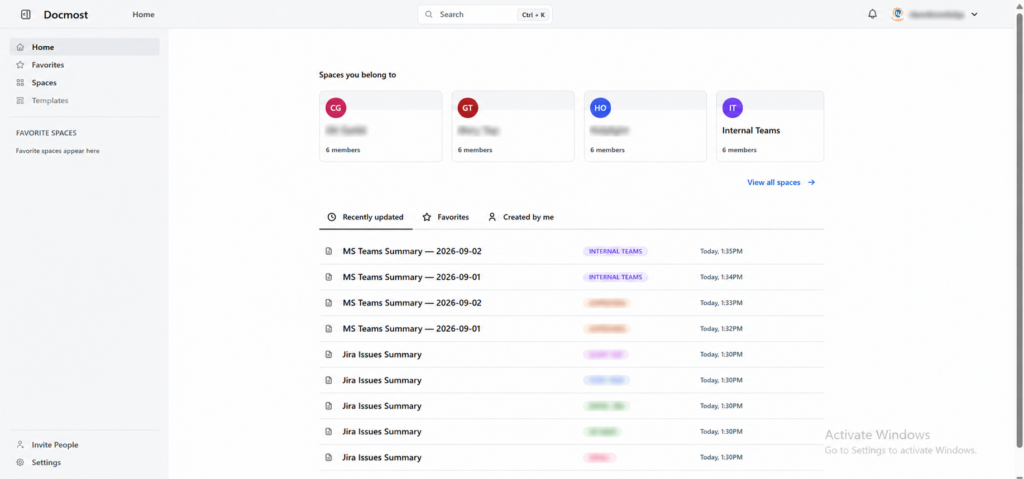
GitHub, Jira and Microsoft Teams provide the source material. Repositories, issues and channel conversations are pulled in without anyone being asked to do anything.
Kimi AI reads all three and writes them up — module documentation from the code, issue summaries from the tracker, and meeting summaries from the chat.
The result: documentation that comes from the work itself rather than from somebody’s memory of it.
FIGURE 1: HOW IT WORKS
Sources
- GitHub — the repository
- Jira — issues and status
- MS Teams — channel conversations
Sync
- Automatic, scheduled
- No developer action required
Kimi AI
- Code into readable language
- Issues and threads into summaries
Docmost
- One space per project
- Searchable, permissioned
One space per project
Each project gets a space, and everything about that project lands in it.
The module documentation, the issue summaries and the conversation summaries sit together under the same heading. Somebody joining a project opens one space rather than three systems.
Each space carries an Overview and a Business Overview — what the project is and what it is for — followed by the generated pages beneath.
What it produces
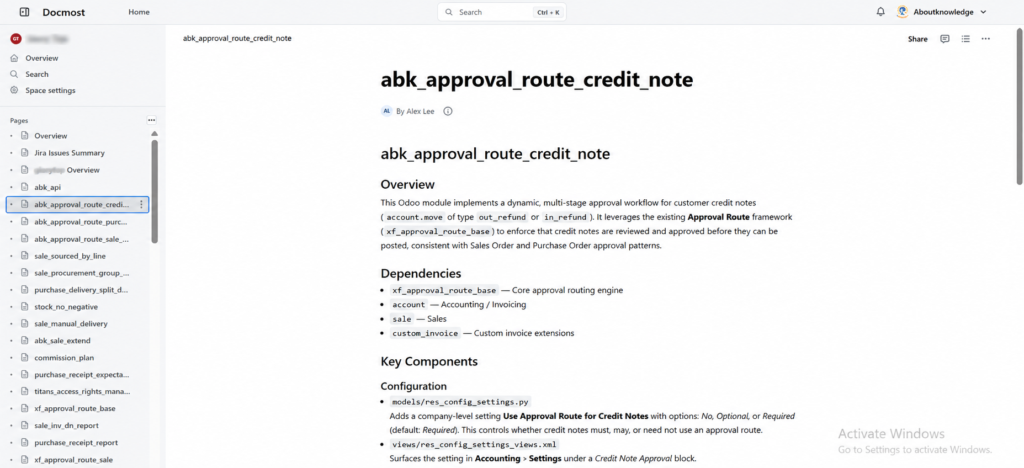
Module documentation from the code. Each module gets a page: what it does, what it depends on, its configuration, models, views, and the workflow from creation through to completion. Written at the level of actual field and file names, so it can be read alongside the code rather than instead of it.
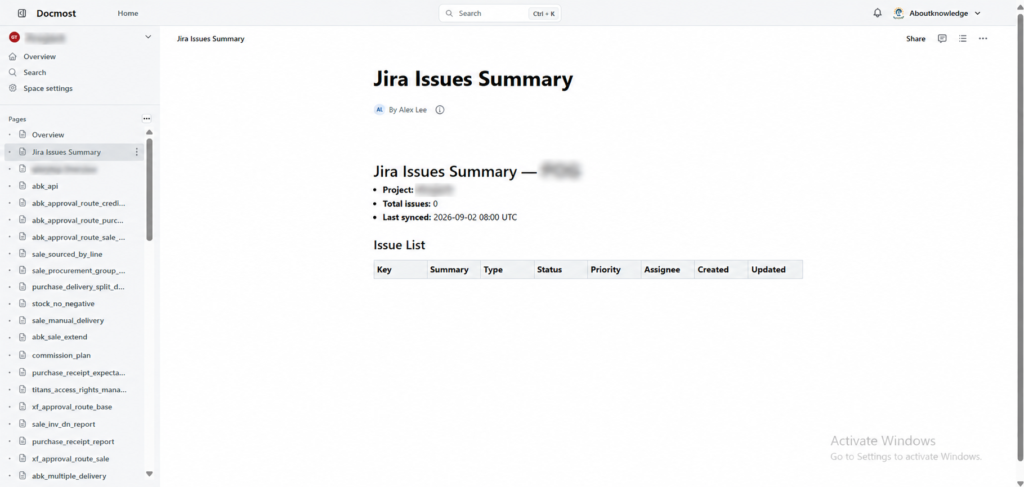
Issue summaries from Jira. Per project — issue key, summary, type, status, priority, assignee and dates, with the time of the last sync stated on the page so nobody has to guess how current it is.
Meeting summaries from Teams. Per channel, per day — an overview, who took part, the topics covered, decisions made, and action items attributed to the person who owns them.
A structure that survives people leaving. The most valuable outcome, and the hardest to achieve any other way.
Why self-hosted
The code does not leave your infrastructure.
For anything under a client confidentiality agreement, or any codebase that represents your own commercial value, that is not a preference — it is a requirement. The same applies to internal conversations, which are often more sensitive than the code.
Docmost is fully self-hosted and supports self-hosted or cloud language models, so both the documentation and the model that writes it can run where you control them.
No per-seat licence either. A team wiki that grows with headcount stops having a cost that grows with it.
Where the human stays
Generated documentation is a first draft, not a final word.
A model reading code can describe what it does. It cannot always say why it does it that way — the business reason, the constraint, the decision that was made and the alternative that was rejected.
The summaries are honest about this. Where a conversation reached no conclusion, the page says no decisions were recorded rather than inventing one. Where a project has no open issues, the table is empty rather than padded.
So the pipeline generates, and a developer reviews and adds what only they know.
That is far faster than writing from nothing, and it produces documentation that is both complete and correct.
FIGURE 2: WHAT THIS CHANGES
Before
- Documentation written once, then stale
- Code, issues and chat in three places
- New developers reading code to understand it
- Decisions lost in old chat threads
- Knowledge leaving with people
After
- Documentation generated from the work
- One space per project, all three sources
- Background available before reading
- Daily summaries with owners named
- A draft to review rather than blank pages
The stack
Docmost — open-source collaborative wiki, self-hosted. Node.js, PostgreSQL and Redis. Spaces, granular permissions, page history, real-time editing, and importers from Confluence and Notion.
GitHub — repositories, synced automatically.
Jira — issues, per project, with sync timestamps.
Microsoft Teams — channel conversations, summarised daily.
Kimi AI — the model reading all three and writing the pages.
Licensing note: Docmost core is AGPL 3.0. Enterprise features including SSO, AI and API access are under a separate enterprise licence.
Who this suits
Development teams with a codebase older than their newest developers. Which is most of them.
Teams running several client projects at once. One space each, and the context does not have to be rebuilt every time somebody switches between them.
Anyone who cannot send code or internal conversations to a third-party service. Self-hosting is the whole answer.
Teams paying per seat for Confluence and wondering whether the bill is proportionate to the value.
Organisations where knowledge leaves when people do. Which is the underlying problem this solves.
Code that only two people understand?
Get in touch. We build self-hosted documentation pipelines that read your repositories, your issue tracker and your team chat, and produce the background a new developer needs — without any of it leaving your infrastructure.